The Myth of the Million
What 1 Million Spotify Streams Actually Pays and What 1,000 Fans on Tipify Could Earn You Instead
By The Tipify Team · · 20 min read
Here is the number. 1 million Spotify streams pays an independent artist approximately $3,000–$5,000 in gross royalties, and after distributor cuts, often closer to $2,400–$4,250 in net earnings. That is what the milestone looks like in real money. Now here’s the counter-punch: 1,000 fans tipping $5 a month on Tipify = $4,500/month to the artist = $54,000 a year, from a dedicated core of just 1,000 people. Before we go any further, hold both of those numbers in your head at the same time. Because that contrast is what this entire post is about.
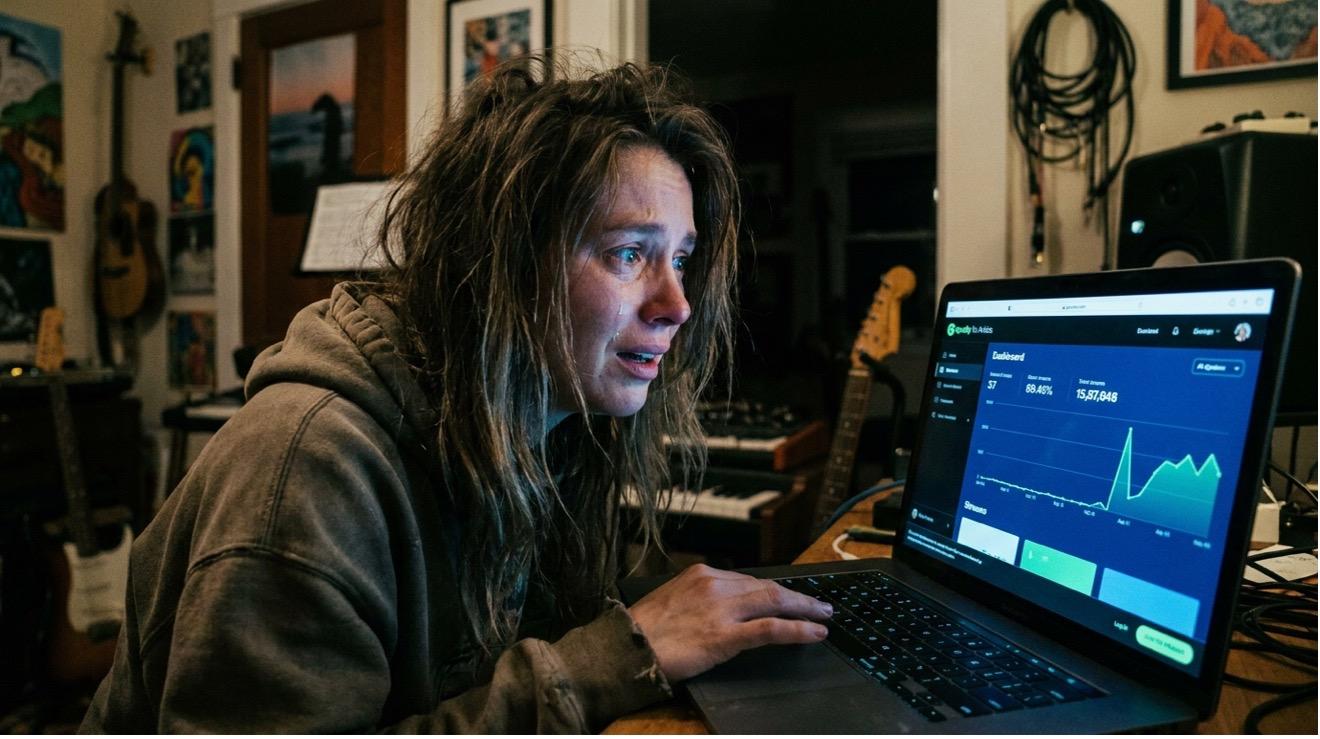
Picture this. An independent artist is sitting at their desk at 11pm. Their Spotify for Artists dashboard is open on their laptop. The stream counter rolls over. 1,000,000. One million plays. A milestone they’ve been chasing for two years, through late-night recording sessions, self-funded releases, relentless social posting, and the quiet, grinding faith that the work would eventually reach people.
They screenshot it. They post it. The comments flood in: fans, friends, fellow artists, all celebrating the number like it means what everyone has always been told it means. And it does mean something. It means people listened. It means the algorithm picked them up somewhere. It means momentum, credibility, proof of life.
Then they check their distributor payout.
The number staring back at them is not what they imagined.
This post is for that artist, and for every fan who has ever wondered what their love for independent music is actually worth in economic terms. Because the gap between the cultural story of streaming success and the financial reality of streaming payouts is one of the most important, least understood truths in modern music. And the solution to that gap might be smaller, and more human, than anyone expected.
The Myth of the Million: Why Streams Don’t Mean Money
Let’s start with the myth. Because it is a myth, and it has been sold so effectively, for so long, that even artists who know better still feel the rush when the stream count climbs.
1 million streams is a cultural milestone. It is not a financial one.
The two things are not the same, and treating them as synonymous has caused real harm to real artists. Streaming platforms have spent years marketing the dream of going viral, of hitting milestones, of algorithmic discovery, because that story serves their growth. What they talk about far less is what those streams actually pay. And when you look at the numbers, you understand why.
Spotify’s royalty model is not a fixed per-stream rate. Contrary to what many artists believe, Spotify does not pay a set amount for each play. Instead, the platform pools its total music revenue each month and divides it proportionally among all streams that occurred during that period. This is what’s called the streamshare model, and it’s why the per-stream rate fluctuates, why it changes by country, by listener type (free vs. premium), and by subscription tier. The industry-standard estimate lands between $0.003 and $0.005 per stream. That’s less than half a cent. Per play.
The math compounds from there. Starting in April 2024, Spotify introduced a 1,000-stream minimum threshold, meaning that any track that hasn’t reached 1,000 streams in the past 12 months is excluded from the royalty pool entirely. For artists with smaller catalogs or newer releases, this means some of their work generates zero payout, regardless of whether anyone listened.
And then there’s the competition. According to independent artist revenue statistics, approximately 12 million artists uploaded music to Spotify in 2024. Of those 12 million, only 71,200, roughly 0.6%, generated $10,000 or more in royalties from the platform. Read that again. 0.6%. The other 99.4% of artists on Spotify earned less than $10,000 from streaming in an entire year.
The “streams = income” equation has been sold to artists as the dream. It’s not a dream. It’s a metric. And metrics don’t pay rent.
A million streams sounds like success. But when the payout arrives, most artists find out it barely covers a month’s rent.
This is not a criticism of streaming as a discovery tool. Spotify, Apple Music, YouTube. They are extraordinary for getting music in front of new ears. The problem is when artists are led to believe that streams are also a viable income model. For the overwhelming majority of independent musicians, they simply aren’t. The platform that gets you heard is not the same as the platform that gets you paid.
So now that we’ve named the myth, let’s do the actual math. No rounding. No approximations. No spin.
How Much Does Spotify Actually Pay for 1 Million Streams?
The numbers are not complicated. That’s what makes them so confronting.
According to Chartlex’s 2026 analysis, Spotify’s per-stream rate in 2026 sits between $0.003 and $0.005. Apply that to 1 million streams and you get a gross payout of $3,000 to $5,000. That’s before anyone else takes their cut.
And people will take their cut.
$0.003 per stream. That’s the rate. It doesn’t negotiate.
If you’re distributing through an independent distributor (DistroKid, TuneCore, CD Baby, Amuse), it will typically take between 15% and 20% of your royalties. After those fees, the net payout to the artist drops to approximately $2,400–$4,250. That’s what 1 million streams actually puts in your pocket as an independent musician.
If you’re signed to a label, the math gets even more brutal. The label takes their advance recoupment, their split, their administrative fees, all before you see a single dollar. For most signed artists, 1 million streams is essentially a promotional metric, not a payday.
How does Spotify compare to other platforms? Not well, but with important nuance.
- Apple Music pays significantly more per stream, approximately $0.007–$0.010 per play, which translates to $7,000–$10,000 for 1 million streams at gross. The catch: Apple Music commands a smaller global market share, which means most independent artists accumulate far fewer total streams there. Higher rate, lower volume.
- Amazon Music pays approximately $0.004 per stream, landing at around $4,000 for 1 million streams, marginally better than Spotify’s floor, but nothing transformative.
- YouTube Music sits at the bottom of the pile at approximately $0.002 per stream, meaning 1 million streams on YouTube Music generates roughly $2,000 gross. That’s less than minimum wage for a week’s work in most English-speaking countries.
To put the Spotify number into further context: Spotify paid the music industry more than $11 billion in 2025, a genuinely staggering figure. But the critical question isn’t how much Spotify paid. It’s who received it. The answer, as Loud & Clear’s own data shows, is: primarily the top. The 13,800 artists who generated $100,000 or more. The major labels. The established acts. The independent artist grinding through their third release? They are a rounding error in that $11 billion.
To earn $54,000 a year from Spotify streams alone, an artist would need to accumulate between 10.8 million and 18 million streams, every single year, consistently. And that’s not a one-time achievement. That’s a recurring requirement. Miss a year, put out less music, lose algorithmic favor, and the number drops.
Now let’s talk about why independent musicians need direct fan support, because the other side of this equation tells a completely different story.
What Can 1,000 Fans Actually Do for an Independent Artist?
There’s nothing arbitrary about that number. Nearly two decades ago, in an essay that became a touchstone for independent creators, the writer Kevin Kelly argued that you don’t need millions of fans to sustain a career, you need roughly 1,000 true fans: people who will support you directly and consistently. Streaming made that idea feel quaint, because it trained everyone to chase scale. Tipify makes it practical again.
Here’s where the math gets interesting. And by interesting, we mean genuinely, legitimately thrilling, in a way that no streaming dashboard ever managed.
Let’s start small. A single $5 tip on Tipify. One fan, one decision, five dollars. The artist receives $4.50, 90% of the tip, directly, immediately. No quarterly payouts, no minimum thresholds, no distributor taking a slice before it even reaches the royalty pool. Just money, moving from a fan who cares to an artist who needs it.
How much is that $4.50 worth in streaming terms? At Spotify’s standard rate, $4.50 represents the earnings from 900 to 1,500 streams. A single fan, a single tip, outperforms the streaming value of a song being played on repeat for hours.
Now scale that up. Not to millions. Just to 1,000.
1,000 fans each tipping $5 per month:
- = $4,500 delivered to the artist every month
- = $54,000 deposited directly into their account every year
- = The streaming equivalent of 10.8 million to 18 million Spotify plays, annually, reliably, predictably
That number, $54,000/year, comes not from a viral moment, not from algorithmic luck, not from a label deal or a sync placement. It comes from 1,000 people making a deliberate, human choice to show up financially for an artist they believe in.
Want to see what happens when you raise the tip amount?
1,000 fans each tipping $10 per month:
- = $9,000 to the artist every month
- = $108,000 per year
- = The streaming equivalent of 21.6 million to 36 million Spotify plays annually
500 fans tipping $10 per month still delivers $54,000/year, the same annual income as over ten million streams, from a community half the size. 250 fans tipping $20/month delivers the same figure again.
The math scales aggressively in the artist’s favor. Because the key variable isn’t the size of the audience; it’s the depth of the connection.
1,000 people. That’s it. 1,000 people choosing to tip $5 a month can generate the streaming equivalent of over ten million plays, every single year.
Here is why that number matters so much psychologically, and not just financially: 1,000 people is not a massive audience. It’s not a viral fanbase. It’s the people who already follow the artist on Instagram. It’s the regulars at their local shows. It’s the listeners who have the album memorized, who share the music with their friends, who have been waiting for the next release. These fans already exist for most independent artists. They just haven’t had a direct, meaningful way to convert their passion into support.
Tipify gives them that option. And understanding what percentage of tips go directly to artists, a transparent 90%, is what makes the whole equation feel real rather than theoretical.
This isn’t about replacing streaming. Streaming is discovery. It’s how new fans find the music. But direct fan support is how artists fund the next chapter of their career. The two aren’t competing. They’re complementary. One gets you heard. The other gets you paid.
The numbers make the case. But numbers, as any songwriter knows, are just the skeleton. The soul of this story is the fan who actually does this, who they are, what drives them, and why their $5 is the most powerful force in independent music right now.
What Does It Actually Feel Like to Be the Fan Who Shows Up?
Think about the last artist you discovered and fell in love with. Not a stadium act. Not a household name. Someone smaller. Someone whose music felt like it was written specifically for you, in a moment when you needed exactly that sound.
Maybe you found them through a playlist. Maybe a friend sent you a link. Maybe their track showed up in a TV show or a TikTok edit and you spent the next two hours going through their entire catalog. However it happened, you know this feeling. The feeling of finding something real.
Now think about what you did with that feeling. You streamed the album on repeat. Maybe you followed them on Instagram. Maybe you shared the link with someone else. Maybe you showed up to a small venue on a Tuesday night and stood twenty feet from the person who made the music that’s been living rent-free in your head for months.
And then? You probably went home and didn’t do anything else. Not because you didn’t care, but because there was nothing else obvious to do. The conventional options available to a fan who wants to support an independent artist are limited: stream more (barely registers), buy merch if it exists, share on social (valuable, but it doesn’t pay the rent). None of these send money directly to the person making the music.
Tipify gives fans a fourth option. A $5 tip. A $10 tip. A monthly subscription that ensures the artist receives consistent support without the fan having to think about it every month. Something that actually, tangibly, financially moves the needle.
Imagine what it feels like on the other side of that transaction. An artist wakes up to a tip notification. Alongside the money is a message from someone they’ve never met, someone in a different city, maybe a different country, who writes: “Your music got me through something hard this year. Thank you.”
The artist doesn’t just receive money. They receive proof. Proof that what they’re making matters. That it’s reaching people. That the late nights and the self-doubt and the financial strain are building something real in someone else’s life. No streaming algorithm delivers that. No quarterly royalty statement tells you that you helped someone through something.
You don’t need to be rich to change an artist’s life. You need to be one of a hundred people who decided to show up.
There’s a community dimension here too. When fans tip on Tipify, artists rise through the platform’s genre-based TipCharts, fan-powered rankings that create organic discovery for other listeners. A tip does double duty: it’s financial support and it’s discoverability. The fan who tips isn’t just helping the artist; they’re helping other fans find the artist too. It’s a virtuous loop, built on human choice rather than algorithmic mystery.
And unlike streaming, the connection on Tipify is personal. Artists can send direct thank-you messages to every supporter. Fans can include notes with their tips. It turns a financial transaction into a relationship, the kind that no platform built on passive listening can replicate.
If you’re a fan reading this and feeling that click of recognition, that yes, this is what I’ve been missing, start discovering and supporting artists on Tipify. Everything you need to know about how it works as a fan is right in the Tipify FAQ. And as Musically reported when Tipify launched, this is exactly the kind of tips economy independent music has been waiting for.
The fan who shows up changes the equation. But the artist still needs to know what that changed equation actually unlocks for them. Because $54,000 a year isn’t an abstract number; it’s a list of real things that real artists can do with their careers.
What Does $54,000 in Direct Fan Support Actually Unlock for an Independent Artist?
Let’s make this tangible. Because “financial support” is an abstract concept until you see what it buys, and what it makes possible.
$54,000 a year, $4,500 a month, from 1,000 fans who each tip $5. Here is what that number looks like when it becomes decisions, not just income:
- A professional recording session at a mid-tier studio runs approximately $500–$1,500 per day. $54,000/year means many sessions, a full EP recorded, mixed, and mastered at a quality level that self-funded bedroom productions often can’t match.
- Regional tour costs (travel, accommodation, venue deposits, equipment transport) become fundable rather than aspirational. An artist with $4,500/month in reliable income can plan a run of shows without gambling their rent money on ticket sales.
- A professional music video, even a thoughtfully produced, cinematic one, can be made for $2,000–$5,000 with the right director and crew. Direct fan income funds that asset without requiring a label advance or a crowdfunding campaign.
- A PR campaign or playlist pitching service, the kind that actually gets songs in front of playlist editors and music journalists, runs $500–$2,000 for a campaign cycle. Without it, most independent artists are invisible outside their existing fanbase. With it, they have a real shot at growing.
- Equipment upgrades like a better microphone, a quality audio interface, or studio monitors that tell the truth about how a mix sounds are the tools that separate demo-quality recordings from release-ready ones. They’re also consistently out of reach when streaming is your only income.
- Digital marketing and social advertising, paid promotion on Instagram, TikTok, YouTube, can run $300–$800/month for meaningful reach. That’s the difference between growing an audience and hoping the algorithm notices you.
Every item on that list is a career investment. Every one of them is routinely out of reach for independent artists whose only income stream is Spotify royalties.
But there’s a deeper point here than just the money. The way direct fan income arrives is fundamentally different from streaming royalties. Streaming royalties are delayed, sometimes by months, distributed quarterly or monthly in arrears, dependent on minimum payout thresholds, and subject to fluctuation based on how the royalty pool is divided in any given period. Tipify income arrives directly and immediately to the artist’s connected Stripe account. No holding periods. No minimum thresholds. No waiting until a quarterly cycle completes.
$54,000/year. That’s the difference between chasing music in your spare time and making it your living.
There’s also the question of creative freedom. An artist whose income comes directly from fans is accountable to one audience: the people who love what they make. They don’t owe a label a commercially viable single. They don’t owe a distributor a minimum release schedule. They don’t owe an algorithm any particular sound or format. The music they make is the music they want to make, and their fans are funding exactly that. That freedom is not a small thing. For most independent artists, it’s everything.
Remember: only 0.6% of the 12 million artists on Spotify earned $10,000 or more from the platform in 2024. Direct fan support gives the other 99.4% a viable, artist-owned path to sustainability, one that doesn’t require going viral, doesn’t require label infrastructure, and doesn’t require the algorithm to smile on you this quarter.
Streaming tells you how many people listened. Tipify tells you how many people believe in you enough to do something about it.
If you’re an artist reading this and wondering how to actually get to 1,000 fans on Tipify, the platform mechanics are designed to make that journey as direct as possible. Here’s how it works.
How Does Tipify Actually Work for Artists and Fans?
This is the part where we get concrete. Because the math works, the mission is clear, and the emotional case has been made, but none of it matters if the platform is confusing or inaccessible. Tipify was built to eliminate that friction entirely.
The Spotify Integration: Your Existing Audience, Activated
One of Tipify’s most powerful features is how it removes the cold-start problem for artists. When fans sign up for Tipify, they log in with their Spotify account. The platform automatically surfaces artists they already listen to who have Tipify profiles, meaning an artist’s existing Spotify audience becomes their immediate potential supporter base the moment they join. There’s no need to build from zero. The fans are already there. Tipify connects the dots.
TipCharts: Support That Creates Discoverability
As fans tip artists on Tipify, those artists rise through genre-based TipCharts, fan-powered rankings that function as a discovery engine for other listeners. More tips means more visibility, which means more fans discovering the artist, which means the potential for more tips. It’s a virtuous loop that rewards genuine fan engagement rather than gaming an algorithm. Learn how TipCharts and artist discovery work on Tipify, because this is the feature that turns 1,000 fans into 2,000.
Direct Messaging: The Human Layer
Artists can send personal thank-you messages to every supporter. Fans can include messages with their tips. This direct, human communication layer is what no streaming platform has ever offered, and it’s what transforms a one-time financial transaction into an ongoing relationship. An artist who knows who their supporters are, and can reach out to them personally, has something no algorithm can manufacture: a real community.
Monthly Subscription Tipping: Predictable, Recurring Income
Fans can set up recurring monthly tips, not a one-off impulse, but an ongoing commitment. This is what makes the 1,000-fan math so powerful in practice: it’s not a windfall that arrives once and disappears. It’s a stable, predictable income stream that the artist can actually plan around. Budget for. Build a career on.
Complete Fee Transparency
- 90% goes directly to the artist
- 5% goes to Tipify
- ~5% goes to Stripe (payment processing)
- No minimum follower count. No approval process. No albums required.
The full breakdown is here. No hidden fees. No fine print surprises. You only pay a fee when you earn.
A Global Platform, Built for Independence
Tipify will soon be available across the UK, US, Europe, Australia, Canada, anywhere Stripe operates. There are no gatekeepers. Any independent musician can sign up today for free and begin building the direct fan income that streaming was never designed to provide. The platform’s growing credibility is further underlined by its partnership with SPIN Magazine, the “Road to Austin” showcase launched in February 2026 brought fan-powered artist discovery to one of music’s most respected editorial platforms.
The platform is live. The infrastructure is real. The only remaining question is the decision.
The Streams Count. But the Fans? The Fans Change Everything.
Here’s the truth, stripped of all the data and the math and the platform mechanics: 1 million streams and 1,000 fans are not playing the same game.
Streaming is passive, algorithmic, and unpredictable. It can spike and vanish. It can plateau for years. It pays in fractions of cents, months after the listening happened, subject to conditions the artist never agreed to and can’t control. It is a discovery mechanism dressed up as a revenue model, and the music industry has spent years pretending those are the same thing.
Direct fan support is human, immediate, and relational. It is 1,000 people making a deliberate choice to invest in music they love. It is $5 that carries a message attached. It is an income stream that doesn’t care about the algorithm, doesn’t require a viral moment, doesn’t depend on a platform deciding your music deserves to be heard this week.
The music industry has always been built to favor the established, the labels, the legacy acts, the infrastructure of the mainstream. Tipify is one of the first tools genuinely designed to level that playing field. Not by fighting the algorithm. Not by petitioning for fairer streaming rates. But by bypassing the intermediary entirely and putting the financial relationship where it has always, at its most honest, belonged: between artists and the people who love what they make.
The fan has more power than they’ve been told. The artist has more options than the streaming economy would have them believe. And the gap between those two truths is exactly where Tipify lives.
The streams count. But the fans? The fans change everything.
Ready to Be Part of It?
For Artists
You make the music. Let your fans fund the journey.
Tipify is free to join. No follower minimum. No approval process. Just a direct line between you and the fans who already believe in you, and the ones who are about to discover you.
For Fans
Your favorite artist is out there. And they need more than a stream.
Discover the independent artists you already love, powered by your Spotify listening history, and tip them directly. 90% goes straight to them. No middlemen. No mystery.