AI vs Human Artists
AI Is Flooding Streaming Platforms: Here’s Why Human Artists Need Direct Fan Support More Than Ever
By The Tipify Team · Published · 16 min read
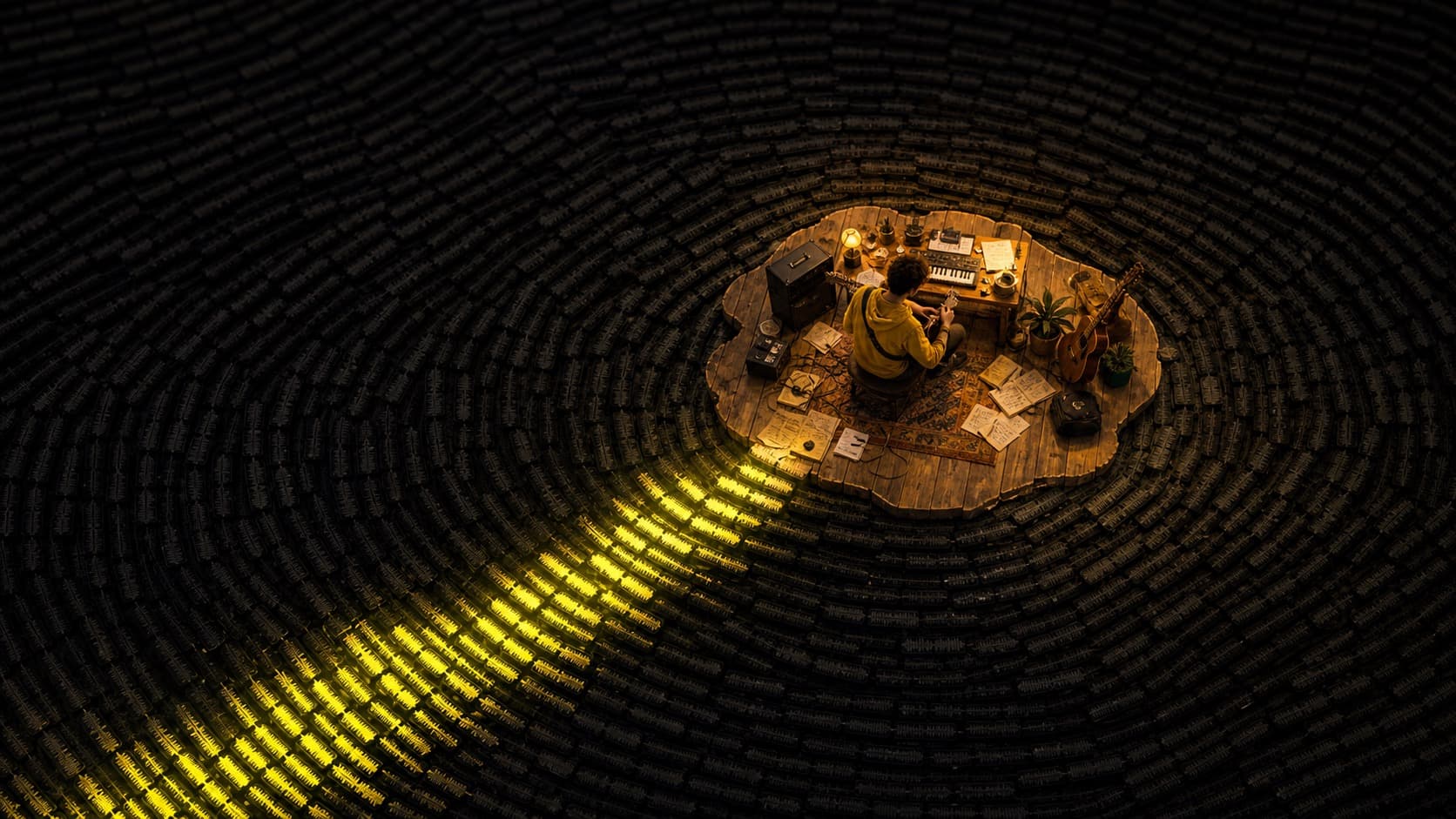
Right now, as you read this sentence, thousands of AI-generated songs are being uploaded to the very platforms where real artists are trying to be heard. Not next year. Not in some speculative future. Right now.
Streaming was supposed to be the great equalizer for independent musicians: no label required, no gatekeeper standing between a song and an audience. That promise was already shaky. Algorithms have long favored volume, velocity, and the artists who already had a head start. But AI hasn’t just tilted that playing field. It has flooded it.
Here is the thesis we’re building this whole piece around: when algorithms fail artists, fans are the answer. Not more streams. Not smarter recommendation engines. Direct, human, fan-to-artist support is what sustains human creativity when the system meant to reward it gets overwhelmed by synthetic content.
We’re sounding the alarm, and we’re doing something about it.
In the next few minutes, we’ll walk through the scale of AI’s takeover of streaming uploads, what it actually costs real artists trying to build a career, what listeners feel (even when they can’t quite name it), how the industry is starting to respond, and why direct fan support is the fix that no algorithm update can replace. Then we’ll show you how Tipify was built for exactly this moment.
Let’s start with the numbers. They’re worse than you think.
The Numbers Don’t Lie: AI Music Has Taken Over Streaming Uploads
This is the alarm bell. Here are the numbers, and they are staggering.
In June 2026, over 50% of all new music uploaded to Deezer was AI-generated. That’s more than 90,000 tracks per day at peak. This is not a fringe issue or a novelty trend. It is the mainstream reality of the platforms millions of people use every day to discover music.
The trajectory got here fast. In December 2025, AI-generated tracks made up roughly 30% of new Deezer uploads. By April 2026, that number had climbed to 44%. By June, it crossed 50%. That’s a climb of roughly 3.3 percentage points a month, and there’s no sign of it slowing down.
At peak in June 2026, over 90,000 AI-generated tracks were uploaded to Deezer in a single day: that’s more than one song per second.
Deezer isn’t an outlier. Apple Music executives have confirmed that over a third of daily uploads to their platform are 100% AI-generated. And the tools behind this flood are staggering in scale on their own. Suno, one of the leading AI music generation platforms, produces roughly 7 million songs per day. At that pace, Suno alone could recreate Spotify’s entire catalog of more than 100 million tracks every two weeks.
The money behind this is just as dramatic. The AI music market was valued at $6.65 billion in 2025 and is projected to reach $60.44 billion by 2034, a 27.8% annual growth rate. This isn’t a side hustle for a handful of startups. It’s a fast-growing industry with real capital behind it.
Zoom out, and the broader picture is just as overwhelming: 253 million tracks now sit on streaming platforms, with 106,000 new songs uploaded every single day in 2025 alone, a 7% increase year-over-year even before you isolate the AI-generated share.
Here are the numbers, laid out plainly:
- December 2025: ~30% of new Deezer uploads are AI-generated
- April 2026: ~44%
- June 2026: 50%+, over 90,000 tracks per day at peak
- Suno: 7 million AI songs generated daily
- AI music market: $6.65B (2025) projected to $60.44B (2034)
- Total tracks on streaming platforms: 253 million, with 106,000 new uploads daily in 2025
This isn’t a story about the future of music. It’s a story about the platform you probably opened this morning.
With the scale of AI music flooding now clear, the next question is the one that matters most: what does this actually cost the real, human artists trying to build a career?
The Hidden Tax on Human Artists: How AI Flooding Hurts Independent Musicians
The discovery crisis was already existential before AI entered the picture. In 2025, 88% of all tracks on streaming platforms received fewer than 1,000 streams. Nearly half the entire catalog, approximately 120.5 million tracks, received fewer than 10 streams in their lifetime. Independent artists were already fighting for scraps of attention. AI has made that fight harder.
And it’s independent artists who are most exposed. 96.2% of daily uploads come from independent artists, DIY musicians, and non-label sources, yet major-label algorithms and editorial playlists still tend to favor established acts. AI amplifies that imbalance instead of correcting it, because the system now has to sort through millions more tracks to find the human ones worth surfacing.
Then there’s the money. Every AI-generated track that earns even a fraction of streams pulls from the same shared royalty pool that human artists depend on. Spotify removed 75 million spam and AI tracks in the 12 months ending September 2025, a number close to the size of their entire catalog. That wasn’t a routine cleanup. It was a response to organized, large-scale fraud.
Much of that fraud follows a simple, cynical pattern: scripts generate thousands of songs, those songs get uploaded in bulk, and bot streams collect micro-payments at scale. It’s engineered theft from a royalty pool that real musicians rely on to pay rent, buy studio time, and keep making music.
As AI floods search results and recommendation engines, human artists, especially emerging and independent ones, get pushed further from discoverability. The algorithm rewards volume and velocity. AI wins both, every time.
And musicians know it. In a 2026 PRS for Music survey, 80% of musicians said they are worried about AI-generated music competing with human-created music. That’s not a niche anxiety. It’s the defining concern of a generation of working musicians. In the same climate, 93% of musicians say they want compensation if their work is used to train AI models, a particularly bitter irony given that many of the tools now flooding their platforms were trained on music made by artists just like them.
88% of all tracks on streaming platforms received fewer than 1,000 streams last year. Then AI arrived and uploaded 90,000 more songs per day.
Picture the person behind these numbers: an independent musician in a home studio, mixing a track late at night, hoping it finds even a small audience. That person isn’t competing with other musicians anymore. They’re competing with a machine that can produce more music in an hour than they’ll release in a lifetime.
We see you, we understand what you’re up against, and we’re angry on your behalf.
The crisis is clear. But what does the listening public actually think about all this? And are they even aware it’s happening?
What Fans Don’t Know (But Feel): The Listener Experience in the Age of AI Music
Here’s an uncomfortable fact: most listeners can’t tell the difference. In a Deezer and Ipsos study from November 2025, 97% of participants failed to correctly identify the AI-generated song in a line-up of three tracks (two AI, one human). Even more telling, 71% were surprised by their own results. People assume they’d know AI music when they hear it. Most of them wouldn’t.
But here’s the critical nuance: being unable to detect AI music doesn’t mean listeners value it the same way. When they’re informed which track is which, listeners consistently prefer human-created music. Emotional authenticity still matters to people. They just can’t always detect it under algorithmic presentation, buried in a playlist with no context.
And that gap seems to be closing as awareness grows. An NPR-covered study from May 2026 found that overall listener interest in AI music dropped, moving from -13% to -20% sentiment over the study period. As people learn more about what they’re listening to, enthusiasm for AI music appears to fade rather than grow.
Listeners are also telling us clearly what they want. 80% support labeling AI-generated music so they know what they’re hearing. And 52% believe AI-generated songs shouldn’t compete in music charts alongside human artists at all.
There’s a real irony sitting underneath all of this. Fans are being handed AI content by the same algorithms they trust to help them discover music they’ll love. The platforms that promise discovery are quietly filling the queue with synthetic tracks, and most listeners have no idea it’s happening.
This isn’t hypothetical. Remember the “Velvet Sundown” controversy, where an anonymous AI-driven act was presented to audiences as a human band. When fans discovered the truth, many felt genuinely deceived, not because the music itself changed, but because the relationship they thought they had with the artist turned out to be an illusion.
Fans want to know whether and how generative AI has been used in the music to which they listen.
Fans have never been passive in the story of music. Their choices, their support, their advocacy have always shaped which artists rise. The real question isn’t whether fans care. It’s whether the tools available to them actually let them act on that care, and support the artists they genuinely connect with.
The industry has started to respond to all of this. But as we’ll see next, regulation and labeling alone won’t be enough to save the artists who need help the most, right now.
The Industry Responds: Labels, Lawsuits, and Why Regulation Alone Isn’t Enough
The crisis has become serious enough to prompt real, industry-wide action. That’s worth acknowledging.
On July 10, 2026, the RIAA and IFPI launched a unified AI labeling program, joined by the Grammys, SAG-AFTRA, and other major organizations. The voluntary framework distinguishes between tracks labeled “AI-generated” (fully synthetic) and “AI-assisted” (a human artist used AI as a tool in the creative process). Platforms including Spotify and Apple Music are beginning to build systems that let distributors and labels voluntarily disclose AI involvement through metadata.
Grammy CEO Harvey Mason Jr. put the intent behind the program plainly:
This initiative ensures that creativity, authorship, and artistic intent remain at the center of every song.
Platforms themselves are taking independent action too. Deezer has committed to systematically removing AI tracks connected to streaming fraud, along with tracks that haven’t been streamed in at least six months, and has launched an AI slop playlist scanner to catch synthetic content before it spreads. Tidal has gone further still, announcing that 100% AI-generated tracks will not earn royalties on its platform at all. And Spotify’s removal of 75 million spam and AI tracks over 12 months shows a platform locked in a war of attrition: pull down what you can find, knowing more will arrive tomorrow.
These are real steps, and they deserve credit. But here is the critical limitation running through all of them: they protect the ecosystem at the platform and label level. They do very little for the individual artist at the center of this story.
Think about an emerging independent musician with 200 monthly listeners, no label, no PR budget, and no editorial playlist placement. None of these policies put money in that artist’s pocket today. None of them restore visibility tomorrow. None of them build the community that artist needs to sustain a career.
The gap that remains is stark. Policy and regulation move slowly by design. Algorithms still don’t distinguish the value of a human-made song from an AI-generated one; they largely just measure volume and engagement. The royalty pool is still being diluted. And the emerging artist, the one this whole system was supposed to help discover an audience, is still invisible.
If policy can’t move fast enough to protect emerging artists, and if algorithms were already stacked against them before AI arrived, then there’s only one force that can move the needle immediately: fans who choose to support human artists directly.
The Real Solution: Why Direct Fan Support Is the Antidote to Algorithmic AI Flooding
Here’s the heart of it. The algorithm cannot be fixed fast enough to save emerging artists today. Direct fan support bypasses the algorithm entirely. It’s a human-to-human transaction that no AI can replicate, dilute, or game.
Small contributions create real, tangible change. A tip that funds recording equipment, covers travel to a gig, or pays for the mastering of a debut single isn’t a passive “like” buried in an engagement metric. It’s a direct investment in a human creative career. Small contributions, big changes: that’s what shaping the future of music actually looks like in practice.
When a fan tips an artist, they’re sending a signal that goes far beyond the transaction itself. They’re saying: I see you. I choose you. Over the noise, over the AI, over the algorithm, you. That kind of human validation cannot be replicated by a bot or generated by a machine, no matter how sophisticated it gets.
Music equity requires active participation, not passive consumption. Right now, the streaming model concentrates 49.4% of all global streaming activity on just 0.2% of available tracks. Direct support doesn’t operate on that concentration model. It distributes power and money to the artists who actually need it, not just the ones who already have it.
This is where Tipify comes in. Tipify’s TipCharts create a genuinely new form of discoverability. Unlike algorithmic charts that favor established artists and high-volume uploaders, TipCharts reflect real fan investment. An artist rises because real people chose to support them, not because an AI flooded the system with 90,000 tracks in a day.
Transparency is at the foundation of how Tipify works. There are no hidden fees and no fine print buried in a terms of service page nobody reads. Fans can see exactly where their support goes. In a landscape defined by algorithmic opacity and synthetic content, that kind of transparency is genuinely radical.
There’s also a community model at work here that isn’t new so much as it is timeless. Fans coming together to fund a specific project, a new album, a first tour, a music video, echoes the collective patronage that built music culture long before streaming ever existed. It worked then, and it works now.
And crucially, artists stay in control. On Tipify, artists manage their own profiles, interact directly with the fans supporting them, and receive support they can actually direct toward what their music needs next. That’s the opposite of the streaming model, where artists are largely passive recipients of whatever the algorithm decides to reward.
When algorithms fail artists, fans are the answer. Every tip is a vote for human creativity.
Before we wrap up, let’s answer the questions artists and fans are asking most right now about AI music and what they can actually do about it.
Your Questions Answered: FAQ on AI Music and Independent Artists
How is AI-generated music affecting independent artists?
AI-generated music is diluting the shared royalty pool that independent artists depend on, while worsening an already severe discoverability crisis. With 253 million tracks now on streaming platforms and 88% receiving fewer than 1,000 streams, the flood of AI content pushes human artists further from visibility. It’s no surprise that 80% of musicians, according to a PRS for Music survey, say they’re worried about AI competing directly with human-created music.
What can fans do to support human musicians against AI music?
Fans can tip artists directly through platforms like Tipify, which bypasses algorithmic gatekeeping entirely and puts support straight into an artist’s hands. Attending live shows, sharing music intentionally, and choosing to engage beyond passive streaming all matter too. Even small financial contributions have a tangible, immediate impact on an artist’s ability to keep creating.
How much of streaming music is AI-generated in 2026?
As of June 2026, over 50% of new uploads to Deezer, more than 90,000 tracks per day at peak, are AI-generated. Apple Music executives have confirmed that over a third of daily uploads to their platform are 100% AI-generated, and the AI tool Suno alone generates 7 million songs per day. Spotify removed 75 million spam and AI tracks over a 12-month period in an effort to stem the tide.
Should streaming platforms label AI-generated music?
Most listeners think so: 80% of people surveyed support labeling AI-generated music so they know what they’re hearing. The industry has started to respond, with the RIAA and IFPI launching a voluntary labeling initiative on July 10, 2026 that distinguishes “AI-generated” from “AI-assisted” tracks. Grammy CEO Harvey Mason Jr. has said the initiative is designed to keep “creativity, authorship, and artistic intent” at the center of every song, and platforms like Deezer are already building AI detection and tagging tools.
How does Tipify help human artists compete with AI music?
Tipify enables direct fan-to-artist financial and emotional support that bypasses algorithmic gatekeeping altogether. Its TipCharts create discoverability based on real fan investment rather than upload volume, so artists rise because people chose them, not because a system was flooded with content. Combined with transparent tipping and a community-driven model, Tipify gives artists and fans a way to build a career and a following on their own terms, together.
Conclusion
The streaming landscape has been fundamentally changed. AI is not a future threat we need to prepare for. It’s today’s reality, sitting at over 50% of new uploads and still climbing.
The industry’s response deserves honest acknowledgment. Labeling initiatives and platform enforcement are real, meaningful steps. But they move slowly, and they tend to protect established structures first, well before they reach the independent artist in a home studio trying to build something from nothing.
Underneath all the statistics is something much simpler. Music has always been about connection: between a person who felt something deeply enough to create it, and another person who hears it and feels a little less alone. That connection is the one thing no algorithm and no AI model can manufacture.
We believe in music equity: giving every artist a fair chance to succeed. No algorithm, no AI flood, and no industry gatekeeper should get to silence the next great voice before it’s even been heard.
Fans and artists aren’t passive participants in this story. They’re the movement. Every direct tip, every genuine moment of engagement, every choice to seek out and support a human artist is an act of creative resistance.
This is our moment.
Discover real artists you can directly support on Tipify.
The music that moves you was made by a human who needs your support now more than ever. Find them. Tip them. Be part of the movement that keeps human creativity alive.
Are you an independent artist ready to connect directly with fans who believe in you?
Join Tipify and build the community your music deserves, one genuine fan at a time.
No algorithms. No AI. Just fans and the artists they love.